

We are seeing a massive shift toward automation across platform engineering and the FinOps teams today. We are firmly getting to the era of Agentic AI :-) Teams are deploying LLM-powered agents to query cloud bills in plain English, parse observability data, and automatically open Pull Requests to _sometimes_ optimize cluster manifests.
On paper, it sounds like the ultimate FinOps dream: AI finds the details of cloud bills, waste, writes the patch, and cuts the cloud bill!!!
But in reality? Many of these AI-generated lifecycles are still hitting a wall.
Why? Because while an AI agent is incredibly smart at analyzing data and writing code, it doesn’t change the underlying laws of Kubernetes infrastructure. Great that users now don’t have to sift through a boat load of CUR files data to analyze spend! But how about not only identifying the efficiency opportunities but also fixing them in real time without causing SLA disruption. As an example, a spiky workload needs almost real time updates to its CPU or memory allocations.
If we want AI-driven automation to actually succeed in Kubernetes, the underlying infrastructure engine needs to be as dynamic as the workloads themselves.
The Execution Gap: Real-Time Impact Testing
Any recommendation, no matter how advanced the model, is still a calculation based on historical telemetry. It cannot perfectly predict how a live, fluctuating production workload will react to a sudden resource constraint right now.
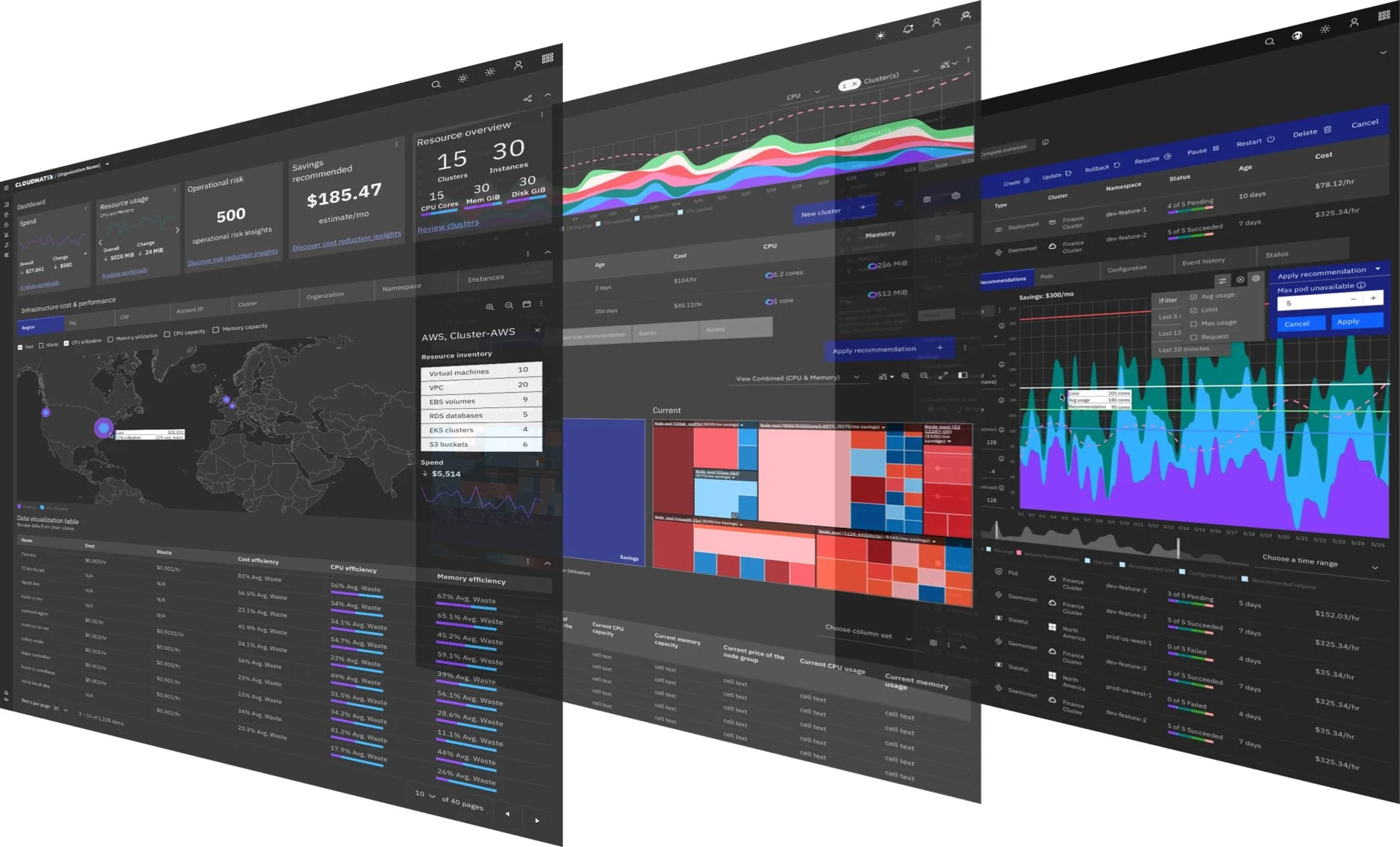
To bridge this trust gap between AI agents and human SREs, we built CloudNatix with a core design philosophy: real-time validation. For manual operations, CloudNatix allows teams to apply that resource shift in real time and instantly visualize the impact on application performance and cluster utilization. Instead of flying blind through a slow CI/CD loop, you see the telemetry move live. This turns a high-risk infrastructure guessing game into a safe, predictable engineering science.
The Brain Needs Muscle: Scaling In-Place Upgrades
When the Kubernetes community graduated In-Place Pod Resizing to production-ready status, it unlocked a foundational API primitive: the ability to mutate a running container’s CPU and memory allocations without destroying the pod.
It was a massive step forward, but an API capability is not an enterprise-ready automation strategy. Knowing how to change a pod's resources in-place is entirely different from orchestrating that capability safely across hundreds of production clusters.
If we try to hammer a native Kubernetes cluster with rapid resize API calls, it quickly trips over real-world edge cases, like race conditions on almost fully saturated nodes, accidental OOMs etc.
This is where CloudNatix acts as the critical execution layer. We didn't reinvent the API; we built the hardened enterprise orchestration engine on top of it.
The CloudNatix Autopilot Continuum
CloudNatix extends native Kubernetes features into a comprehensive Autopilot engine that is now already running reliably across hundreds of customer environments.
Instead of traditional vertical autoscaling (which forcefully evicts pods and introduces traffic thrashing), our Autopilot handles the heavy lifting of execution. It continuously processes real-time telemetry, calculates safe boundary steps, and executes non-disruptive, in-place upgrades on the fly.
If an AI agent triggers a resizing action, CloudNatix ensures the application never drops a request and pods stay alive. If an underlying node physically runs out of headroom to accept an in-place expansion, only then does our Autopilot gracefully orchestrate intelligent bin-packing, moving workloads smoothly without breaking production SLAs.
Empowering the Automated Enterprise
AI agents are excellent at identifying what to optimize, but they lack the infrastructure guardrails to do it safely at scale.
True Kubernetes efficiency requires a platform that matches the speed of AI with the safety of a hardened runtime engine. By combining our proprietary ML driven performance and utilization insights with CloudNatix’s in-place Autopilot, engineering teams can finally take themselves out of the loop and let automation work the way it was always intended to.
How is your team currently handling Kubernetes rightsizing? Are you letting AI agents write your infrastructure patches yet, or are evictions still causing production headaches?